
Embroidery may look simple when viewed on a finished garment, but creating a high-quality embroidered design requires careful planning, technical skill, and the right software. A logo or piece of artwork must be converted into a stitch file that an embroidery machine can understand. 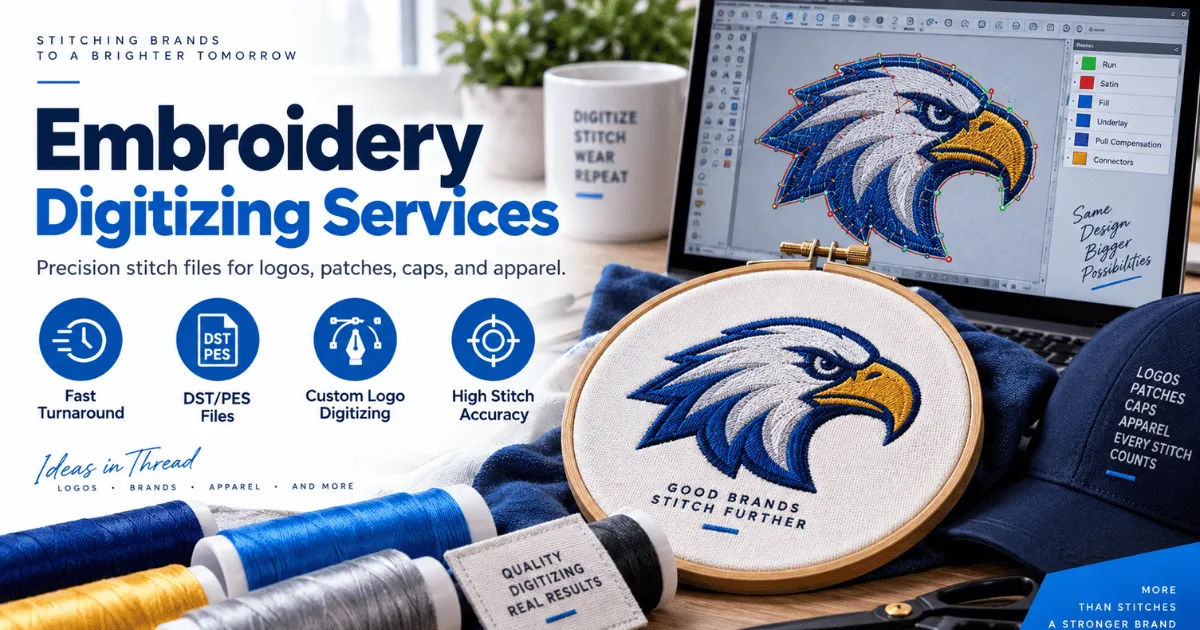
A reliable embroidery digitizing company does much more than convert an image into stitches. It studies the artwork, selects suitable stitch types, considers fabric behavior, adjusts stitch density, manages thread changes, and prepares a file that can produce clean results. The goal is not simply to create a digital file but to create a file that performs properly during actual embroidery.
For businesses, clothing brands, promotional companies, sports teams, and individual customers, reliability means receiving consistent quality without unnecessary delays or repeated corrections. Understanding the qualities of a dependable digitizing provider can help you make a better decision before sending your artwork for conversion.
Embroidery Digitizing
Embroidery digitizing is the process of converting artwork into a digital embroidery file. Unlike ordinary graphic files, embroidery files contain instructions for a machine.
These instructions tell the machine where to stitch, what type of stitch to use, which direction the stitches should follow, when to stop, and when to change thread colors.
A skilled digitizer must understand both design and embroidery. Simply tracing an image with software is not enough. The digitizer needs to know how stitches behave on different fabrics and how various design elements will appear after stitching.
For example, a small letter may require a different approach from a large filled logo. Thin lines, small details, curves, borders, and overlapping elements all require careful treatment.
Experience and Technical Knowledge
One of the strongest signs of a reliable embroidery digitizing company is experience. Digitizing requires technical knowledge that develops through practice and exposure to different types of projects.
An experienced digitizer understands common embroidery problems before they occur. They know that a design that looks perfect on a computer screen may not necessarily stitch well on fabric.
Experience also helps with difficult artwork. Complex logos may contain gradients, tiny details, thin outlines, or complicated shapes that cannot be reproduced exactly through standard stitching.
A professional digitizer knows how to simplify certain details without damaging the identity of the original design.
Understanding Different Stitch Types
Reliable digitizers understand when to use satin stitches, fill stitches, running stitches, and other embroidery techniques.
Satin stitches are often useful for borders, lettering, and narrow shapes. Fill stitches can cover larger areas, while running stitches can create fine outlines and details.
Using the wrong stitch type can result in poor coverage, unnecessary thread buildup, or an unattractive appearance.
Knowledge of Fabric Behavior
Fabric affects embroidery significantly. Cotton, denim, jackets, caps, fleece, performance fabrics, and other materials can respond differently to stitching.
A dependable provider considers the intended fabric before completing the digitizing process. They may adjust density, underlay, stitch direction, or other settings to improve the final result.
High-Quality Digitizing Software
Professional digitizing software is another important factor. A reliable embroidery digitizing company should use suitable industry-standard tools rather than depending on basic image-conversion software.
Professional software provides greater control over stitch placement, density, underlay, sequencing, pull compensation, and other technical settings.
However, software alone does not guarantee quality. Two people can use the same software and create very different results.
The skill of the digitizer remains extremely important because the software must be controlled correctly.
Proper Stitch Planning
Good digitizing involves planning the order in which different areas will be embroidered.
Poor sequencing can create unnecessary jumps, thread changes, or overlapping problems. Good sequencing helps make production smoother and can improve the appearance of the finished design.
A reliable provider pays attention to these details before delivering the final file.
Consistent Stitch Quality
Consistency is one of the clearest signs of reliability. A professional provider should be able to produce similar quality across different projects.
A customer should not receive an excellent file one time and a poorly prepared file the next time.
A dependable embroidery digitizing company follows a repeatable quality-control process. Designs should be checked for issues such as excessive density, gaps, unnecessary overlaps, loose stitches, poor outlines, and incorrect sequencing.
Consistency becomes especially important for businesses that use the same logo on many products.
Accurate Reproduction of Logos
Business logos are often used on uniforms, caps, jackets, bags, shirts, and promotional products. Because logos represent a brand, accuracy is extremely important.
A reliable digitizer should preserve the important visual characteristics of the original artwork while adapting it to embroidery.
Some details may need to be simplified because thread has physical limitations. However, those changes should be carefully planned rather than made randomly.
The best providers understand which elements are essential to the brand identity and which details can be adjusted for better embroidery.
Handling Small Details
Small details are among the most challenging parts of embroidery. Tiny text can become difficult to read, while narrow lines can disappear when stitched.
An experienced digitizer evaluates the size of the finished design and makes appropriate adjustments.
For example, very small lettering may need to be enlarged slightly or redesigned so that it remains readable after stitching.
Proper Density Management
Stitch density refers to how closely stitches are placed together. It is a major factor in embroidery quality.
Too few stitches can leave gaps and make the fabric visible. Too many stitches can create unnecessary bulk, stiffness, thread breaks, or puckering.
A professional embroidery digitizing company balances stitch density according to the design, fabric, thread, and embroidery area.
Density should not be treated as a universal setting. Different parts of the same design may require different density levels.
Effective Use of Underlay
Underlay stitches provide a foundation for the visible stitches. They can help stabilize fabric and improve the shape and coverage of embroidered elements.
A reliable digitizer understands that underlay must be selected carefully. Too little support may cause distortion, while excessive underlay can create unnecessary thickness.
The correct approach depends on the fabric and design.
This is another reason why automatic conversion often cannot match professional manual digitizing.
Support for Multiple File Formats
Different embroidery machines can require different file formats. Common formats include DST, PES, EXP, JEF, VP3, and others.
A dependable embroidery digitizing company should understand the differences between these formats and provide the appropriate file for the customer's machine.
Customers should communicate their machine requirements before production whenever possible.
Providing the wrong format can create unnecessary delays, even if the underlying digitizing work is good.
Machine Compatibility
Machine compatibility should always be confirmed before embroidery begins.
A professional provider can help identify which file format is appropriate based on the machine being used.
This attention to technical details can prevent avoidable production problems.
Fast but Reasonable Turnaround
Speed matters in modern business. Customers may need embroidered designs for product launches, events, uniforms, seasonal campaigns, or promotional orders.
However, reliability does not mean promising unrealistic delivery times.
A trustworthy provider gives a reasonable turnaround estimate and communicates if something changes.
A embroidery digitizing company that consistently meets its promised deadlines is more valuable than one that makes extremely fast promises but repeatedly delivers late or incomplete files.
The best balance is speed combined with quality control.
Clear Communication
Communication is another major sign of reliability.
Customers should be able to explain what they need without struggling to understand technical terms. A professional provider should ask useful questions when necessary.
For example, they may ask about the embroidery size, garment type, machine format, thread colors, or intended application.
Clear communication reduces mistakes and helps the digitizer understand the project's purpose.
Asking the Right Questions
A responsible provider does not simply accept artwork and immediately create a file without considering how it will be used.
The digitizer may need to know whether the design is intended for a cap, jacket, shirt, bag, or another product.
This information can influence how the design should be prepared.
Quality Control and Testing
One of the most important characteristics of a dependable embroidery digitizing company is a strong quality-control process.
A digitized file should be reviewed before it reaches the customer.
Depending on the provider and project, quality control may include checking stitch direction, density, thread changes, sequencing, outlines, and design dimensions.
Test stitching can provide even more useful information because it shows how the file behaves on actual fabric.
Why Test Stitching Matters
A computer preview cannot always show how thread will behave on fabric.
Test stitching can reveal problems such as puckering, gaps, excessive density, registration issues, or poor lettering.
For complicated or important designs, testing can be especially valuable.
Ability to Make Revisions
Even well-prepared designs sometimes need changes.
Fabric, machine settings, embroidery size, and customer preferences can all lead to revision requests.
A reliable embroidery digitizing company should have a reasonable revision process.
This does not necessarily mean unlimited changes. Instead, it means the provider should be willing to correct legitimate technical problems and make agreed adjustments.
Good revision policies create confidence and reduce the risk of receiving a file that cannot be used.
Transparent Pricing
Price is important, but the cheapest service is not always the best choice.
Extremely low pricing may indicate limited quality control, automatic conversion, inexperienced digitizers, or minimal customer support.
A professional provider should explain pricing clearly.
Costs may depend on design complexity, size, stitch count, number of colors, required format, and turnaround time.
A trustworthy company avoids confusing charges and provides customers with a clear understanding of what they are paying for.
Strong Customer Reviews and Portfolio
A portfolio can provide useful evidence of a provider's skills.
When evaluating an embroidery digitizing company, customers should look for examples that resemble their own projects.
A portfolio containing logos, lettering, patches, caps, detailed artwork, and other embroidery styles can demonstrate versatility.
Reviews can also provide insight into reliability.
Look for comments about consistency, communication, turnaround time, file quality, revisions, and customer service rather than focusing only on general ratings.
Understanding Different Embroidery Applications
Different products create different digitizing challenges.
Cap embroidery, for example, involves curved surfaces. Flat garments provide different stitching conditions. Patches may require different borders and finishing approaches.
A reliable provider understands these differences.
Cap and Hat Embroidery
Caps can be challenging because the embroidery area is curved and may contain seams.
A skilled digitizer considers stitch direction, center placement, density, and sequencing when preparing a design for headwear.
Jacket and Outerwear Embroidery
Jackets and heavier garments may require different stabilization and stitch planning.
Large designs can also become uncomfortable or overly dense if they are not prepared correctly.
Small Logo Embroidery
Small chest logos require careful attention to lettering and fine details.
The design must remain recognizable even when reduced in size.
Reliable Customer Support
Customer support becomes particularly important when technical questions arise.
A dependable provider should be available to clarify file formats, design requirements, revisions, and production concerns.
Good support does not necessarily require constant communication. It means customers can receive useful answers when they need them.
An embroidery digitizing company that combines technical expertise with responsive support can save customers considerable time.
Protecting Customer Artwork
Businesses often send logos, illustrations, brand assets, and original artwork to digitizing providers.
A trustworthy service should treat customer artwork responsibly.
Customers should understand how their files are stored, handled, and delivered.
For businesses with original branding or proprietary designs, responsible file management can be an important part of choosing a service provider.
Ability to Handle Complex Designs
Not every embroidery project is simple.
Some designs contain multiple colors, detailed artwork, lettering, gradients, shading, or intricate borders.
A professional embroidery digitizing company should be able to evaluate complex designs honestly.
If a specific detail cannot be reproduced effectively with embroidery, the provider should explain the limitation and suggest a practical solution.
This type of honesty is often more valuable than promising something that cannot produce good results.
What Customers Should Look For
Before selecting a digitizing provider, customers can create a simple checklist.
Look for experience, strong portfolio examples, clear communication, reasonable turnaround times, suitable file formats, transparent pricing, revision support, and quality-control procedures.
It is also useful to ask whether the provider understands the intended embroidery application.
A company that asks thoughtful questions before beginning work may be more dependable than one that immediately promises everything.
Warning Signs of an Unreliable Provider
Certain warning signs should make customers cautious.
One common issue is promising perfect results without reviewing the artwork.
Another is providing extremely fast delivery without explaining how quality will be checked.
Poor communication is another concern. If a provider does not respond clearly before receiving an order, customer service may become even more difficult after payment.
Customers should also be cautious when a provider cannot explain basic differences between embroidery formats or refuses to make reasonable technical corrections.
Why Reliability Matters for Businesses
For a business, poor embroidery can damage the appearance of its products.
A distorted logo, unreadable text, uneven stitching, or excessive thread buildup can make a garment look less professional.
Working with a dependable embroidery digitizing company helps businesses maintain consistency across different products.
This is particularly important for brands that produce large quantities of embroidered merchandise.
A good digitizing file can also reduce production problems, saving time and materials.
Building a Long-Term Partnership
Choosing a digitizing provider should not always be viewed as a one-time purchase.
Businesses that regularly produce embroidered products can benefit from developing a long-term relationship with a skilled provider.
Over time, the digitizer becomes familiar with the brand's logos, preferred sizes, fabrics, thread colors, and production requirements.
This can make future projects easier and more consistent.
A reliable embroidery digitizing company becomes more valuable when it understands the customer's recurring needs.
PSA Digitizing is a reliable embroidery digitizing company dedicated to converting artwork and logos into files that embroidery machines can use. The company supports several popular formats, including DST, PES, and JEF, making it easier for customers to prepare designs for different machines. Based in Clarkston, Georgia, USA, PSA Digitizing combines professional digitizing knowledge with modern technology to produce smooth, accurate, and stitch-ready embroidery files.
Its services are suitable for embroidery businesses, clothing brands, designers, and individual hobbyists. PSA Digitizing has maintained a 4.5+ star rating on Trustpilot and continues to focus on quality workmanship, responsive service, and dependable turnaround times. Whether you need a detailed logo digitized or a custom patch prepared, the team aims to keep the process simple and hassle-free. Visit psadigitizing.com to get started with your design.
Conclusion
Reliability in embroidery digitizing comes from a combination of technical knowledge, experience, communication, consistency, and attention to detail. A dependable provider does not simply turn an image into a stitch file. It considers how the design will behave on real fabric and how the embroidery machine will execute every part of the design.
The best embroidery digitizing company understands stitch types, density, underlay, sequencing, fabric behavior, machine compatibility, and design limitations. It also provides clear communication and reasonable turnaround times.
Quality control is equally important. Reviewing files and, when appropriate, test stitching designs can identify problems before they affect a large production order.
Customers should also consider portfolios, reviews, pricing, revision policies, customer support, and the provider's ability to handle different embroidery applications.
Ultimately, reliability means delivering embroidery files that work in the real world. A beautiful computer preview is useful, but the real test is how the design looks and performs after it has been stitched.
For businesses and individuals who depend on professional embroidery, choosing the right embroidery digitizing company can save time, reduce production problems, protect brand quality, and improve the finished product. By evaluating experience, technical skill, communication, quality control, and customer service together, customers can make a confident and informed decision.
A reliable provider is not simply the one that offers the lowest price or fastest delivery. It is the one that consistently understands the customer's artwork, prepares it correctly, communicates honestly, and delivers a file capable of producing clean, professional embroidery.