
A white label LMS allows businesses, schools, training companies, and organizations to offer an online learning platform under their own brand. Instead of building an LMS from scratch, an organization can use an existing learning management system and customize its appearance, name, logo, colors, domain, and other brand elements.This approach makes it possible to create a professional learning experience without handling the technical work involved in developing and maintaining an entire LMS.
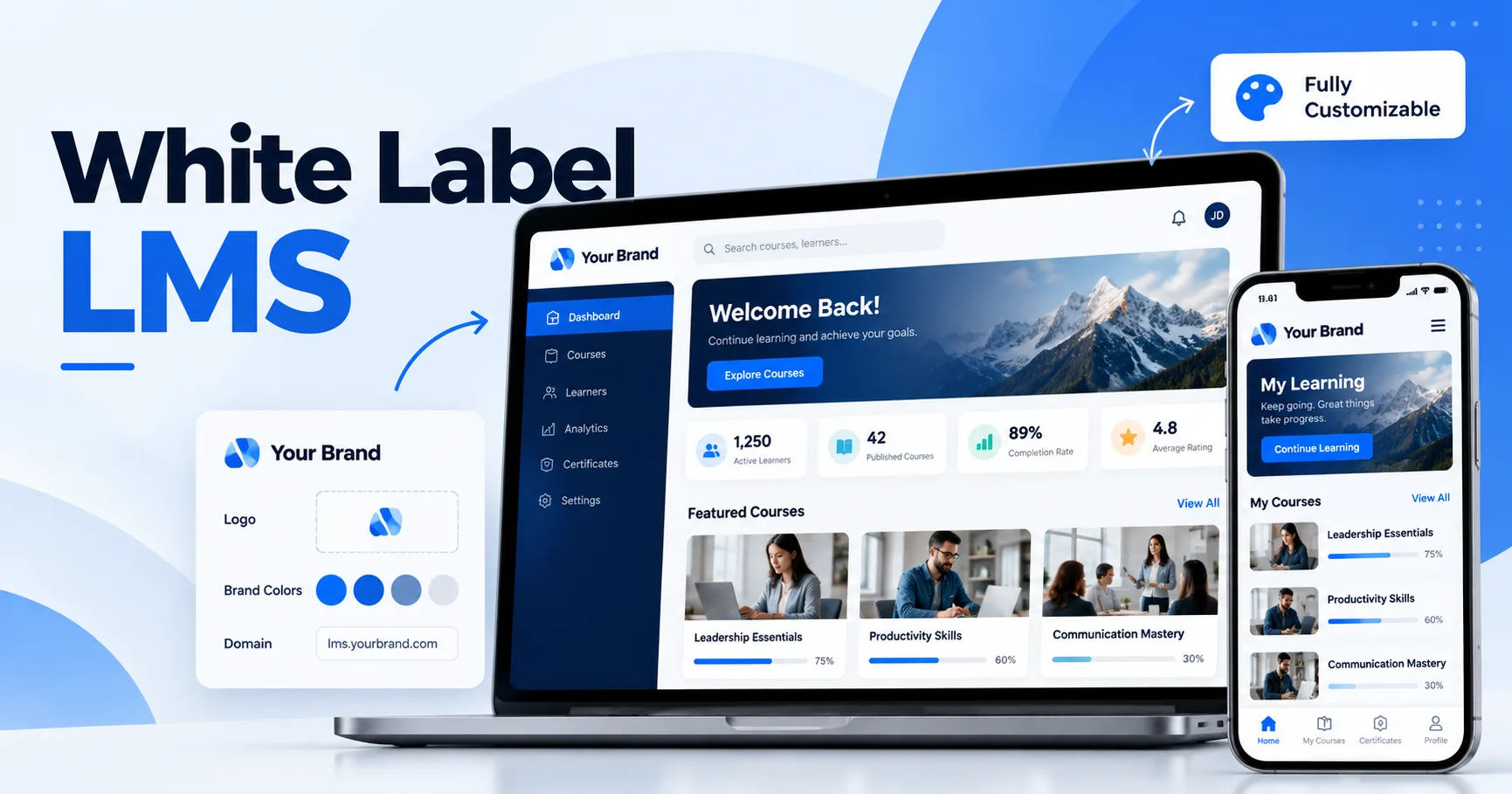
For organizations that want to launch online courses quickly, white labeling can save time, reduce development costs, and create a more consistent brand experience.
What Is White Label LMS Branding?
White label LMS branding is the process of customizing an existing learning management platform so that learners see the organization's branding instead of the original software provider's identity.
The underlying technology is still provided and maintained by the LMS company. However, the front-end experience can be designed around the organization's visual identity.
For example, a corporate training company may use its own:
- Logo
- Brand colors
- Fonts
- Website domain
- Course catalog
- Email templates
- Login page
- Dashboard design
- Mobile app branding
The goal is to make the learning platform feel like a natural part of the organization's digital presence.
How White Labeling Differs From Custom LMS Development
A fully custom LMS is built specifically for one organization. This can provide extensive control, but development may require significant time, money, technical expertise, testing, and ongoing maintenance.
A white label LMS takes a different approach. The core platform already exists, and the organization customizes the available branding and configuration options.
This means businesses can focus more on their courses, learners, instructors, and marketing rather than managing the entire technology infrastructure.
How Does White Label LMS Branding Work?
The exact process depends on the LMS provider, but most platforms follow a similar structure.
Step 1: Choose an LMS Provider
The first step is selecting a platform that supports white labeling.
Organizations should examine the available branding features before making a decision. Some providers may offer simple logo and color customization, while others allow deeper changes to domains, emails, mobile applications, certificates, and learner interfaces.
The organization should also consider scalability, security, integrations, support, pricing, and administrative features.
Step 2: Add Your Brand Identity
After selecting the platform, the organization provides its branding assets.
These can include the company logo, color palette, typography, images, icons, and other visual elements.
The platform provider then applies these elements to the LMS interface according to the available customization options.
This helps create a consistent visual experience between the organization's main website and its learning environment.
Step 3: Customize the Domain
Many white-label platforms allow organizations to use a custom domain or subdomain.
For example, instead of learners visiting a provider-branded address, they might access a learning portal such as:
learn.companyname.com
A branded domain can make the platform easier to recognize and can help create a more professional experience.
It also reduces the visible connection between the learning portal and the underlying LMS provider.
Step 4: Customize the Login Experience
The login page is often one of the first places learners interact with the platform.
Organizations may be able to customize the logo, background, colors, text, and other elements.
A well-designed login page should clearly communicate where learners are and what they can do after signing in.
For example, a corporate training portal might include the company's logo and a simple message such as "Welcome to Your Learning Center."
Step 5: Configure the Learner Dashboard
The learner dashboard is another important part of branding.
Depending on the platform, administrators may customize menus, colors, navigation elements, course categories, banners, and other components.
The dashboard should not only look attractive but also make learning easy to navigate.
Learners should quickly understand where to find their courses, assignments, certificates, progress information, and other resources.
What Can Be Branded in a White Label LMS?
Branding capabilities vary between providers. However, several common elements can usually be customized.
Logo and Visual Identity
The logo is one of the most recognizable elements of a brand.
Replacing the platform provider's logo with the organization's logo helps learners associate the learning environment with the organization itself.
Colors can also be adjusted to match existing brand guidelines.
Domain and URLs
A custom domain can make the learning platform appear more closely connected to the organization's website.
For businesses offering paid courses, this can be particularly useful because the learning portal becomes part of the overall customer journey.
Emails and Notifications
Automated emails are another important branding opportunity.
An LMS may send messages about enrollment, course completion, assignments, password changes, certificates, and other events.
With white labeling, these messages can often be customized with the organization's logo, colors, language, and sender information.
This creates a more consistent experience across email and the learning platform.
Certificates
Certificates can be customized to include organizational branding, course names, instructor information, completion dates, signatures, and other details.
For professional training companies, certificates can be especially important because they represent the organization's educational offering.
Mobile Applications
Some providers offer branded mobile applications as part of their white-label packages.
Instead of learners downloading an app that displays the LMS provider's branding, they may receive an application associated with the organization's own brand.
Availability and customization options vary considerably between providers.
Why Do Businesses Use White Label LMS Platforms?
There are several reasons organizations choose this model.
Faster Launch
Building an LMS from the ground up can take months or longer.
A white-label platform already includes the core learning infrastructure, allowing organizations to configure and launch their learning environment more quickly.
This can be valuable for companies that need to start delivering training without waiting for a long software development cycle.
Lower Development Costs
Custom software development can involve designers, developers, database specialists, security professionals, testers, and maintenance teams.
A white-label solution can reduce the amount of technical development required because the core infrastructure already exists.
The organization generally pays for access to the platform and its available features rather than funding the entire development process.
Stronger Brand Recognition
Brand consistency matters when learners interact with a business through multiple channels.
If a company's website, emails, advertisements, social media accounts, and learning portal all use the same branding, the overall experience can feel more connected.
A white label LMS can help organizations maintain this consistency.
Less Technical Maintenance
The LMS provider usually handles much of the underlying infrastructure, including software updates, hosting, and technical maintenance.
This allows the organization's team to concentrate on creating educational content and supporting learners.
The exact responsibilities depend on the provider's service agreement, so organizations should review these details before purchasing a platform.
White Label LMS for Different Types of Organizations
White labeling is not limited to one industry.
Corporate Training
Companies can create branded employee training portals for onboarding, compliance training, professional development, and internal education.
Employees can access training through a platform that feels like part of the company's internal technology environment.
Schools and Educational Institutions
Educational organizations can use branded learning portals to provide courses, resources, assessments, and communication tools.
A consistent interface can make it easier for students and teachers to recognize the institution's digital learning environment.
Training Companies
Training providers can use white labeling to sell courses under their own brand.
This can be particularly useful when the company wants to focus on educational content and customer relationships instead of developing LMS technology.
Coaches and Consultants
Individual experts and consulting businesses can create branded educational programs for clients.
For example, a business consultant might use a branded learning portal to deliver workshops, recorded lessons, assignments, and downloadable resources.
How Branding Affects the Learner Experience
Branding is not only about making an LMS look attractive.
It can influence how learners understand and interact with the platform.
When the interface is familiar, learners may find it easier to recognize important navigation elements and understand where they are within the organization's digital environment.
However, branding should not interfere with usability.
Too many decorative elements can make a dashboard confusing. Good branding should support clear navigation rather than distract from learning.
Consistency Is Important
A learning platform should ideally use the same basic visual language as the organization's other digital channels.
For example, if the main website uses specific colors, fonts, and terminology, the learning platform can use similar elements.
This creates a connected experience from the first marketing interaction through course enrollment and completion.
White Label LMS and Marketing
A branded learning platform can also support marketing strategies.
When customers purchase an online course, they are not simply buying access to videos or documents. They are also experiencing the organization behind those materials.
A professional learning portal can reinforce brand identity throughout the customer journey.
Supporting Customer Retention
Organizations can use their learning platforms to keep customers engaged after an initial purchase.
New lessons, certificates, assessments, webinars, and additional courses can give learners reasons to return.
The platform can therefore become more than a place to host content. It can become part of the organization's long-term relationship with its audience.
Selling Multiple Courses
Training businesses can organize multiple courses into categories, programs, or learning paths.
A branded platform can make these offerings easier to present under one recognizable identity.
This can also help organizations build a larger educational product ecosystem over time.
Important Features to Consider
Branding alone should not be the only factor when selecting a platform.
Organizations should examine the complete feature set.
Course Management
The LMS should make it easy to create, organize, update, and publish courses.
It may also need support for videos, documents, quizzes, assignments, discussions, and assessments.
User Management
Administrators may need tools for creating users, assigning courses, managing groups, tracking progress, and controlling permissions.
These features become increasingly important as the number of learners grows.
Analytics and Reporting
Reporting tools can provide information about enrollment, course completion, assessment results, learner activity, and other metrics.
These insights can help organizations understand how their educational programs are being used.
Integrations
Organizations may need their LMS to connect with payment systems, customer relationship management software, email platforms, video tools, analytics systems, or other business applications.
Before choosing a provider, it is important to confirm that the required integrations are available.
Potential Limitations of White Labeling
Although white labeling offers many advantages, it does not necessarily provide unlimited customization.
Limited Design Control
Some platforms allow only specific branding changes.
Organizations wanting complete control over every interface element may find these restrictions limiting.
Provider Dependency
The organization depends on the LMS provider for the underlying technology.
If the provider changes pricing, features, policies, or technical infrastructure, those changes may affect the organization.
For this reason, businesses should carefully review contracts, data policies, service levels, and migration options.
Additional Costs
Some advanced branding features may require a higher subscription plan.
Custom domains, branded mobile applications, advanced integrations, or additional administrative features may not be included in the basic package.
Organizations should calculate the total cost rather than looking only at the starting subscription price.
Best Practices for White Label LMS Branding
A successful branded learning platform should balance appearance, usability, and functionality.
Start with a clear brand guideline. Decide which colors, fonts, logos, images, and terminology should be used throughout the platform.
Keep navigation simple. Learners should not have to search through complicated menus to find their courses.
Use consistent terminology. If your organization calls a learning program a "course," avoid switching between terms such as "module," "class," and "program" without a reason.
Test the platform on different devices. Many learners use smartphones and tablets, so the experience should work well across screen sizes.
Finally, ask real learners for feedback. They can identify navigation problems and confusing elements that administrators may overlook.
Conclusion
A white label LMS provides a practical way for organizations to deliver online education through a platform that reflects their own identity. Instead of building every component from scratch, businesses can use an established learning system and customize important elements such as logos, colors, domains, dashboards, emails, certificates, and, in some cases, mobile applications.
The main advantage is the combination of existing technology and customized branding. Organizations can launch learning programs more efficiently while maintaining a consistent identity across their digital channels.
However, choosing the right platform requires more than checking its branding options. Businesses should also evaluate course management, learner administration, analytics, integrations, security, scalability, support, pricing, and data policies.
Ultimately, effective LMS branding should make the learning environment feel like a natural extension of the organization. The technology should remain easy to use, while the visual identity, communication, and learner experience remain consistent with the brand. When these elements work together, a white-label learning platform can become a useful part of an organization's education, training, and customer engagement strategy.